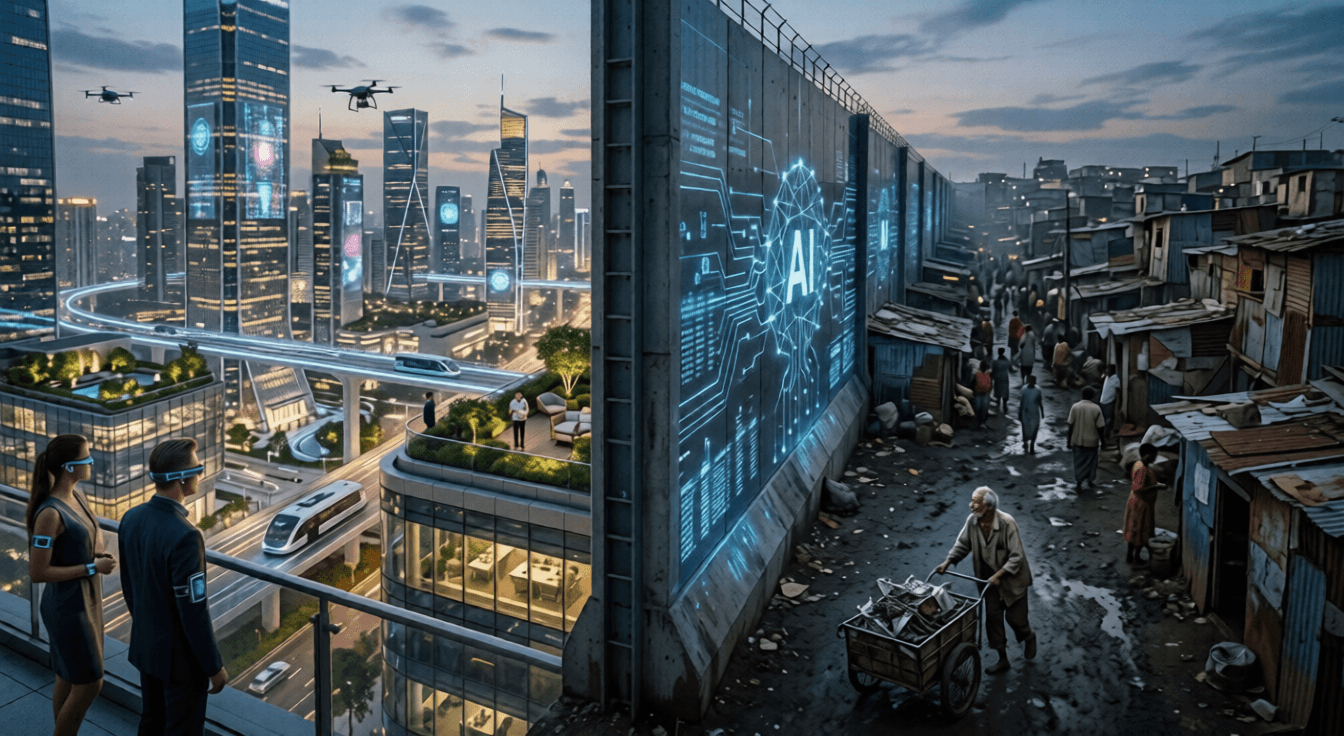
Summary
Artificial intelligence is routinely called the most transformative technology since the internet, but who actually benefits? This piece looks at how AI concentrates early gains among capital owners, displaces middle-income workers while augmenting highly skilled ones, and shifts the balance of power from labour to capital. It also sets out the reasons for optimism: lower barriers to entry, entrepreneurial leverage, and wider access to knowledge. The outcome rests on choices made across policy, education and industry.
Artificial intelligence gets described as the most transformative technology since the internet, sometimes since electricity. Underneath the excitement sits a harder question: who actually benefits? As AI reshapes industries, labour markets and capital flows, it isn't only creating new wealth. It's redistributing opportunity. Whether that redistribution narrows or widens the wealth gap is one of the defining questions of our time.
The Uneven Starting Line
To understand AI's effect on inequality, start with who owns it.
AI development is extraordinarily capital-intensive. Training frontier models takes massive datasets, specialised chips and concentrated expertise. A small number of companies, mostly large technology firms, control the infrastructure, talent and platforms behind modern AI. The economic upside therefore accrues disproportionately to those who already hold capital.
Past technological revolutions followed a similar pattern, with early gains flowing to innovators and investors before diffusing outward. AI may compress that timeline. Unlike earlier technologies, it can scale decision-making, automation and creative output at near-zero marginal cost, which amplifies returns to ownership in ways we haven't seen before.
Labour: Displacement and Augmentation
The effect on workers is more mixed.
AI automates tasks and sometimes whole roles, particularly in customer service, data entry and parts of software engineering. Workers in those roles face wage pressure or displacement, which widens inequality, especially across middle-income jobs.
It also works as a powerful augmenter. One person with good tools can now do work that used to need a team: writing code, analysing data, designing products, running research. In principle that lowers barriers to entry and lets individuals, particularly founders, create value at a scale that was previously out of reach.
The tension sits here: AI raises both the ceiling and the floor, but not at the same rate.
Skilled workers who know how to use it become dramatically more productive. Those without access, training or the room to adapt fall behind. The result is a barbell, with gains concentrating at the top while the middle hollows out.
Capital and Labour: A Shifting Balance
AI also moves the balance between capital and labour.
When machines handle cognitive work, human labour becomes less central in certain domains. That strengthens the position of whoever owns the systems, the data and the infrastructure, and weakens the bargaining power of workers.
This is already visible. Companies scale output without proportional hiring. Startups reach large valuations with small teams. Productivity gains don't reliably show up in wages.
Left uncounterbalanced, that dynamic widens the wealth gap considerably.
The Global Dimension
The gap isn't only within countries. It's between them.
Advanced economies with AI infrastructure and talent are positioned to capture outsized gains. Developing countries built around labour-intensive industries face the disruption without the corresponding upside.
If AI automates outsourced work such as call centres or routine programming, the countries that depend on those sectors contract while the countries leading in AI pull further ahead. That is a new kind of divide layered on top of the inequalities that already exist.
Reasons for Optimism
None of this is inherent to the technology. Under the right conditions AI could be a genuine equaliser.
- Lower barriers to entry: capabilities that were once expensive or exclusive, including legal advice, education, coding and design, become widely available.
- Entrepreneurial leverage: individuals build and scale businesses faster, with far fewer resources.
- Access to knowledge: AI-assisted education and tutoring can widen access to high-quality learning substantially.
The same technology that concentrates power can distribute it. Which one happens depends on how it gets deployed.
What Will Determine the Outcome?
The effect of AI on the wealth gap isn't predetermined. It turns on decisions made across policy, education and industry.
- Access: who gets to use these tools, and at what price?
- Education: are people equipped to work with AI rather than be replaced by it?
- Ownership: can individuals and communities share in the upside, through equity, data ownership, or new economic models?
- Regulation: are there mechanisms to prevent excessive concentration of power?
A Fork in the Road
AI is a multiplier. It amplifies the economic, social and institutional structures it lands in. Where those structures are unequal, it deepens the inequality. Where they are built to include people, it widens opportunity.
One path leads to a world where a small group captures most of the value created by increasingly powerful systems. The other leads to a more distributed economy, where individuals are equipped by the same tools that once required a large organisation.
The technology won't decide which path we take. We will.
Final Thought
AI is a general-purpose amplifier of human capability, and amplifiers don't produce equality on their own. They magnify whatever system they are placed into.
If the current system concentrates wealth, AI accelerates that concentration. Redesign the system with care and it expands access instead.
The technology is neutral. The outcome won't be.