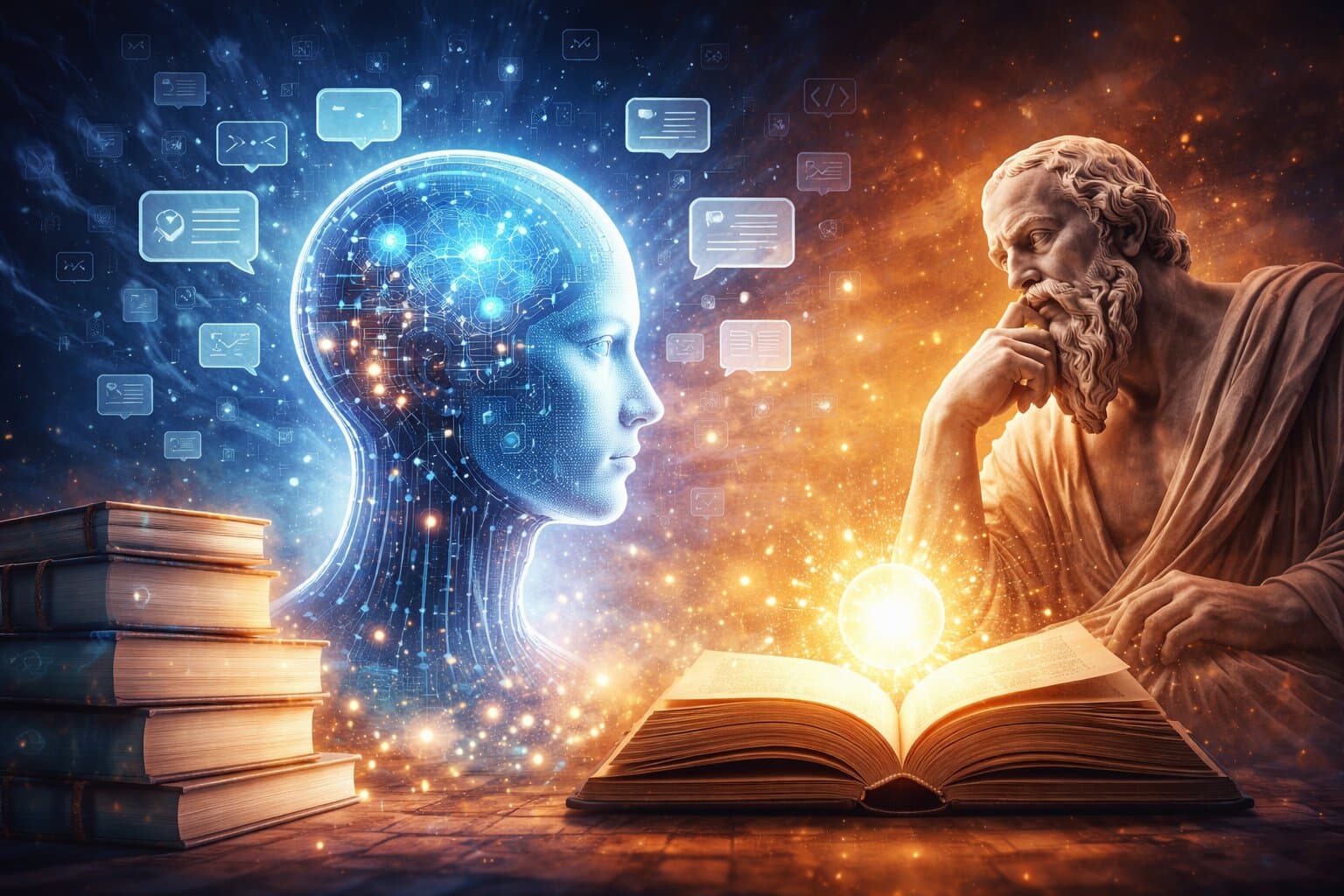
Summary
LLMs can draft legal briefs, write code and hold nuanced conversations, but intelligence is not the same as wisdom. Wisdom requires judgement, values, and the ability to handle ambiguity in ways current models cannot replicate. The more useful goal may not be machines that replace human wisdom, but systems that support and augment it.
Large language models have gone from curiosities to serious engines of reasoning and synthesis. They draft legal briefs, write code, summarise research and hold conversations with real nuance. That is a form of intelligence: processing information, detecting patterns, producing coherent output at scale.
Intelligence is not wisdom.
The distinction is ancient in philosophy and newly urgent in AI. It raises a specific question: can an LLM move from being smart to being wise?
Smart and wise are different things
Smartness is about capability:
- Solving problems efficiently
- Recognising patterns across vast datasets
- Producing accurate or plausible answers
LLMs are excellent at this. Trained on enormous text corpora, they internalise the statistical relationships between words, ideas and structures, and simulate expertise across domains with real fluency.
Wisdom is a different thing:
- Judging when and whether to act
- Weighing long-term consequences against short-term gain
- Handling ambiguity, ethics and competing human values
- Knowing the limits of your own knowledge
Wisdom is about judgement rather than answers. That is where LLMs start to show their limits.
The illusion of understanding
The striking thing about LLMs is how convincingly they appear to understand. They will explain quantum mechanics, argue moral philosophy, or offer life advice. Underneath, they are not reasoning in the human sense. They are predicting.
They have no lived experience, no beliefs or intentions, and no grasp of meaning beyond patterns in data.
That produces a specific failure mode: an LLM can generate wise-sounding responses without being grounded in wisdom. It might give genuinely thoughtful advice on an ethical dilemma while having no stake in the outcome and no way to evaluate consequences in the world.
Why wisdom is hard to engineer
No embodiment. Humans develop wisdom through experience: trial, error, social friction, consequences. LLMs have none of that grounding. They don't live in the world, they model it through text.
No intrinsic values. Wisdom requires values, such as prioritising fairness or minimising harm. LLMs don't hold values. They reflect whatever was present in their training data and alignment process.
Context sensitivity. Wise decisions are deeply situational, and the right answer often turns on subtle factors. Models approximate this well, but they lack genuine situational awareness.
Epistemic humility. A wise agent knows what it doesn't know. Models can be trained to express uncertainty, but they still drift toward overconfidence or hallucination when the situation is ambiguous.
Possible routes to machine wisdom
If wisdom isn't native to these systems, can it be cultivated? Several directions look promising.
Alignment and value learning. RLHF aims to align model output with human preference. More advanced approaches, such as constitutional AI, try to embed ethical principles into behaviour directly. Alignment raises its own hard question: whose values?
Tool use and external feedback. Models can be augmented with retrieval systems, simulations, or human-in-the-loop review that ground their output in reality, improving judgement by verifying facts and modelling consequences.
Deliberative reasoning. Chain-of-thought prompting and self-reflection push models to reason step by step rather than jump to conclusions. It mimics human deliberation, though it remains a simulation of it.
Multi-agent systems. Rather than one model, several can debate, critique and refine each other's reasoning, approximating collective intelligence and more balanced judgement.
Human-AI collaboration. The most realistic route is probably not autonomous AI at all, but hybrid systems where models supply breadth and speed while humans supply judgement, values and accountability.
The risk of confusing the two
As models get more capable, the temptation grows to hand them high-stakes decisions: legal advice, medical guidance, policy recommendations.
This is exactly where the distinction matters. A system that is articulate, confident and usually right can still fail badly when it lacks judgement. Relying on models without understanding their limits leads to poor decisions in critical domains, amplified bias, and the slow erosion of human responsibility.
A better question: augmented wisdom
Rather than asking whether LLMs can become wise, ask whether they can help people become wiser.
Used well, they surface perspectives you hadn't considered, clarify complex trade-offs, challenge your assumptions, and widen access to knowledge. In that role they work as cognitive amplifiers, tools that sharpen human reflection instead of substituting for it.
Where this leaves us
Large language models are genuinely smart, and that is a real achievement. But wisdom isn't a technical problem. It comes out of experience, values and responsibility, in a way statistical systems don't reproduce. We can approximate parts of it through alignment, feedback and careful system design. The rest probably stays out of reach.
So the useful goal isn't machines that replace human judgement. It's systems that support it, extend it, and leave the responsibility where it belongs.
Which makes the real question less about whether machines can be wise, and more about whether we will use them wisely.