Summary
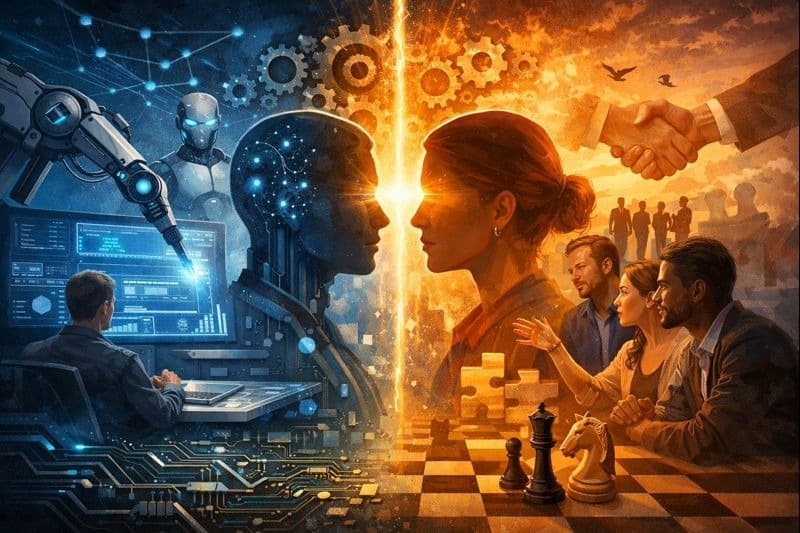
As AI automates coding, writing and analysis, the human differentiator stops being technical execution and becomes judgement, communication and ethics. This piece argues that "soft" skills are the real bottleneck: AI doesn't fix bad judgement, it scales it. The hardest problems ahead are human ones, coordination and trust and legitimacy, and no model solves those. Soft skills sit at the interface between intelligence and impact. As intelligence gets cheap, the ability to direct it well becomes the scarcest skill there is.
For years, "soft skills" was a polite way of saying non-technical.
Communication. Leadership. Empathy. Moral reasoning. Nice to have, hard to measure, usually deprioritised.
Technical skill was treated as the real currency. If you could code, model, analyse or optimise, you were valuable. Everything else was secondary, something you picked up along the way or delegated to management.
AI flips this hierarchy.
Once technical execution is automated, the human differentiators stop being optional. When a machine can generate code, write memos, analyse data and draft strategy at scale, the bottleneck moves from production to decision-making. And decision-making is deeply human.
A badly communicated decision doesn't just fail locally once AI amplifies it. It scales the dysfunction. A misaligned incentive propagates through the system rather than staying contained. AI doesn't fix bad judgement; it accelerates it. It doesn't correct flawed values either. It operationalises them.
That's why soft skills compound so quickly in an AI-enabled world. Clear thinking, ethical judgement, negotiation, persuasion and responsibility all determine how intelligence gets deployed, and who carries the consequences when it goes wrong.
Our institutions still treat these skills as secondary.
We train people to optimise systems but not to lead them. To generate outputs but not to weigh trade-offs. To move fast, but not to stop and ask whether the thing should be done at all.
The result is a widening gap between capability and wisdom.
The hard problems are human problems
As AI systems grow more powerful, the hardest problems stop being technical. They become human: coordination across teams and incentives, trust between institutions and the public, legitimacy of decisions made at scale, and the question of what work means when so much of it is mediated by machines.
Better prompts don't solve any of those. Neither do larger models.
They need people who can listen, explain, persuade and take responsibility, particularly when the outcome is uncertain and the stakes are high. They need leaders who can sit with ambiguity, resolve conflict, and make value-laden calls without hiding behind "the system".
In that sense, soft skills aren't soft at all.
They are the interface between intelligence and impact, the translation layer between what machines can do and what society should permit. As intelligence becomes cheap and abundant, the ability to direct it wisely becomes the scarcest and most valuable skill of all.