Summary
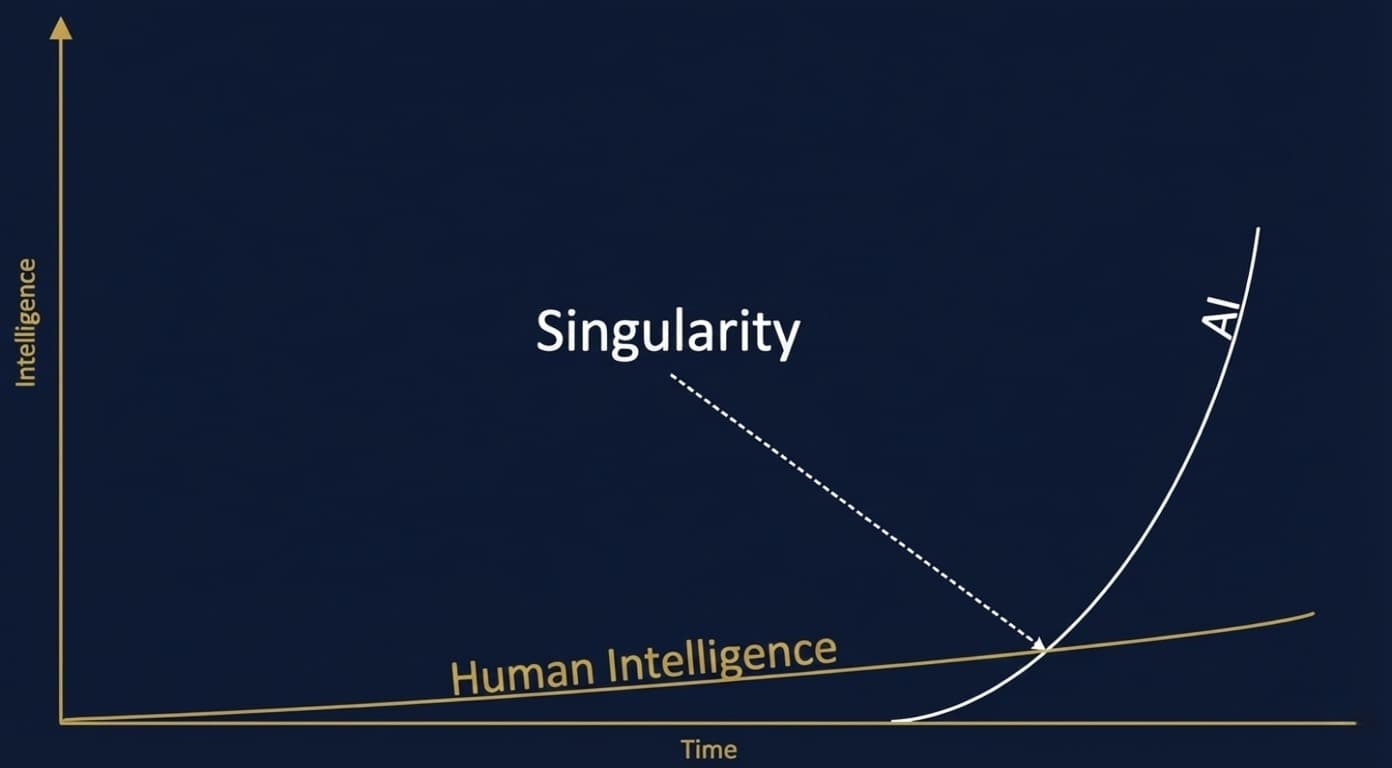
The intelligence explosion debate asks whether AI could jump from human-level to far beyond in a very short time. This post breaks it down in plain language. The core idea is recursive self-improvement: a smarter system improves itself, then gets smarter still. The case for fast takeoff rests on software speed, scaling laws and compounding automation. The case against rests on hardware limits, coordination bottlenecks and diminishing returns. The plausible middle ground is acceleration with instability, meaning bursts of rapid progress followed by plateaus rather than an overnight superintelligence.
If you follow AI casually, few ideas are more confusing than the "intelligence explosion". You'll hear warnings that a system might leap from fairly smart to far beyond human in a very short time, and equally firm insistence that this is unrealistic. The argument can feel abstract or alarmist when you're just trying to work out what's actually at stake.
This is the debate in plain language, with no equations: why some researchers expect a rapid jump, why others expect something slower, and what a realistic middle ground looks like.
Why People Fear a Sudden Leap
When people talk about takeoff, they're picturing a moment where progress stops being incremental and turns explosive, roughly like going from the Wright brothers to the Space Shuttle in a week.
The anxiety isn't baseless. We're used to technology improving smoothly, and AI has had moments that feel discontinuous: a new architecture arrives, gets scaled up, and capabilities appear that nobody observed in earlier versions.
That unpredictability is where the fear starts.
The Core Idea: Recursive Self-Improvement
The argument rests on a simple feedback loop. A system gets smarter, uses that intelligence to improve itself, becomes smarter still, and repeats.
The thought experiment runs like this. Imagine a system capable of writing better algorithms for its own training. Those algorithms make it faster and more capable. With those new abilities it finds further improvements. The loop tightens each time round.
Run that loop over hours or days and you get the classic takeoff scenario.
The Case For Fast Takeoff
Software improves fast. Unlike biological evolution or physical engineering, code can change instantly. A small insight can produce a large jump in performance, and the iteration cycle is measured in minutes rather than months.
Scaling laws. Modern AI follows reasonably predictable patterns: more compute, more data and a better architecture produce smooth but dramatic capability gains. A system that can help design better architectures or gather its own data could accelerate that curve.
Compounding automation. AI that automates AI research produces compounding returns. Automate 10% of the work and progress speeds up. Automate half and it feels qualitatively different. Automate all of it and the pace could become extreme.
The Case Against
Hardware limits. Even the best algorithm runs on physical machines. Chip manufacturing cycles, energy budgets, thermal constraints and supply chains don't disappear because a model wants to improve itself.
Coordination bottlenecks. Real improvements need human and organisational coordination: building data centres, negotiating access, upgrading infrastructure. Much of that can't be automated on the same timescale.
Diminishing returns. The early gains may simply be the cheap ones. Each subsequent improvement could demand exponentially more compute, data or engineering, in which case the curve flattens rather than explodes.
Not every feedback loop spirals upward. Most run into a wall.
What Probably Happens
Past the extremes, a more moderate picture emerges.
Progress will very likely accelerate, because more of the research pipeline is being automated. A genuine overnight explosion looks unlikely, because hardware, economics and coordination all impose real limits.
What we probably get instead is pockets of instability: short periods of unusually fast progress, followed by plateaus while the constraints catch up.
The world probably won't wake up to a superintelligence. It may well wake up to systems arriving faster than institutions, policy and norms can absorb. That gap is where the real risk sits.
Explosion or Not, Preparation Matters
Whether the future is a steady climb or a sharp jump isn't an academic question. It changes how you prepare.
An instantaneous explosion is one possibility among several. A moderate acceleration with destabilising phases is more plausible and still enormously consequential. You don't need a science fiction scenario to justify taking governance, safety research and careful deployment seriously, because the pace of progress already outruns most of our institutions.
Rapid change demands foresight whether or not it turns explosive. The earlier that foresight gets built into technology, policy and culture, the better positioned we are for whatever actually arrives.