Summary
A growing share of the data powering modern AI isn't collected from the real world. It's generated. Synthetic data offers a scalable answer to the data bottleneck, to privacy constraints, and to the problem of rare edge cases. It also introduces new risks: distribution drift, bias amplification, and model collapse. How well AI systems work may come to depend as much on the quality of the data we invent as on the models we build.
Every AI system rests on data. Recommendation engines, self-driving cars, medical diagnostics, large language models: all of them are downstream of what they were trained on.
A growing share of that data is no longer collected. It's generated.
What Is Synthetic Data?
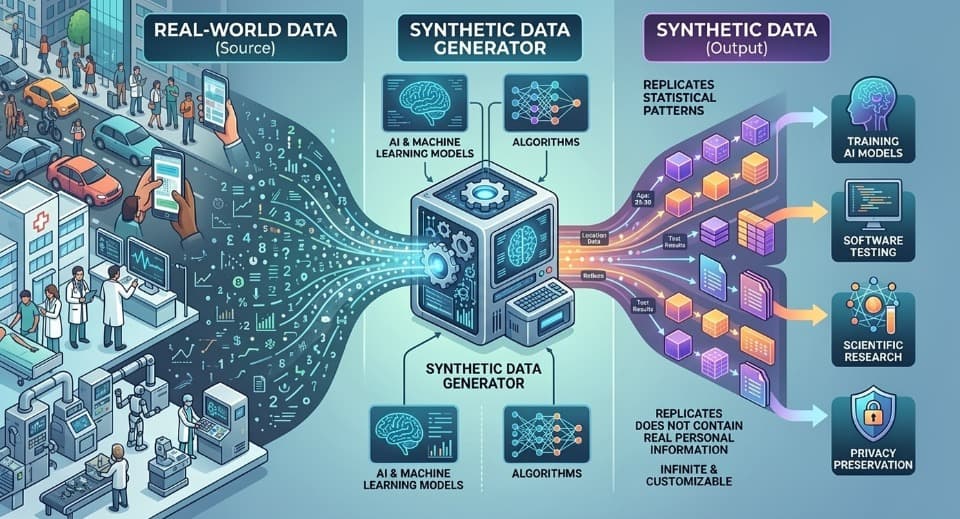
Synthetic data is artificially generated information that mimics the statistical properties of real data without originating from it. It shows up in four main forms:
- Tabular: financial transactions, medical records
- Images and video: simulated driving environments
- Text: generated conversations or documents
- Sensor: IoT streams, robotics inputs
Rather than collecting from users, sensors, or historical records, you create it algorithmically, often using AI models themselves: GANs, diffusion models, or large language models.
Why Synthetic Data Is Taking Off
Real data can't keep up
Modern AI systems are data-hungry. Training a state-of-the-art model often takes millions or billions of examples. Real-world data is expensive to collect, slow to label, and frequently incomplete or biased.
Synthetic data scales differently. Once you have built a generation pipeline, you can produce data on demand in effectively unlimited quantities.
Regulation makes real data costly to hold
As data rules tighten under GDPR, HIPAA and their successors, organisations face growing constraints on how they collect, store and use personal data.
Synthetic data eases that pressure in three ways:
- It removes direct links to real individuals
- It preserves statistical patterns without exposing sensitive records
- It lets teams and organisations share datasets more safely
In healthcare and finance, that difference is substantial.
Rare events are easier to simulate than to capture
Some of the hardest problems in AI involve scenarios that are rare but critical: a pedestrian stepping into the road at night, a fraudulent transaction buried among millions of ordinary ones, an uncommon medical presentation.
Those events are difficult to gather in real datasets and straightforward to simulate. Synthetic data lets developers oversample them deliberately, which improves both robustness and safety.
Some fields train almost entirely in simulation
In robotics, autonomous driving and games, synthetic data isn't a supplement. It's the primary training source.
Waymo, Tesla and NVIDIA all lean heavily on simulated environments to train perception systems, test edge cases at scale, and iterate faster than real-world experimentation would allow. This simulation-first approach is becoming central to how AI gets built.
AI is now generating the data that trains AI
The more interesting dynamic is recursive: AI systems are producing the data used to train the next generation of AI systems.
- LLMs generating synthetic text for fine-tuning
- Vision models creating labelled images for downstream tasks
- Reinforcement learning agents training inside simulated worlds
That feedback loop is powerful. It also carries real risk.
Challenges and Risks
Synthetic data solves several problems and creates others.
Distribution drift
If synthetic data doesn't faithfully reflect real-world distributions, models trained on it fail once deployed. Garbage in, garbage out still holds, just in subtler form.
Bias amplification
Synthetic data inherits the biases of the source data and the generating model, and can magnify them. A model generating hiring data from a historically biased record will reproduce that bias rather than correct it.
Model collapse and contamination
As more systems train on data generated by other systems, quality can degrade through recursive training on artificial output. This is an active research question, particularly for large language models trained on internet-scale corpora that increasingly contain AI-generated text.
Evaluation is genuinely hard
Judging whether synthetic data is good enough remains difficult. Statistical similarity to the source doesn't reliably predict real-world usefulness.
Where Synthetic Data Is Headed
Synthetic data looks likely to become a standing part of the AI stack rather than a workaround.
Hybrid pipelines. The future isn't purely synthetic. Real data grounds and validates the system; synthetic data supplies scale, diversity and edge cases.
Data as a product. Companies are starting to treat synthetic datasets as products in their own right: pre-built datasets for specific industries, simulation environments for training agents, APIs that generate custom data on demand.
Foundation models for data generation. Just as we have foundation models for text and images, models built specifically to generate high-quality, domain-specific datasets with minimal human input are beginning to appear.
Regulatory recognition. Regulators are starting to treat synthetic data as a legitimate privacy-preserving tool. Expect clearer frameworks over the next few years.
What this changes
Synthetic data shifts the constraint. Instead of being limited by what we can collect, we are limited by what we can convincingly generate, and by how well we can tell the difference.
That is a harder problem than it sounds, and it moves the burden onto validation. The fairness and reliability of the next generation of AI systems will rest heavily on how carefully their training data was built and checked, by people who understood what the real world actually looks like.