Summary
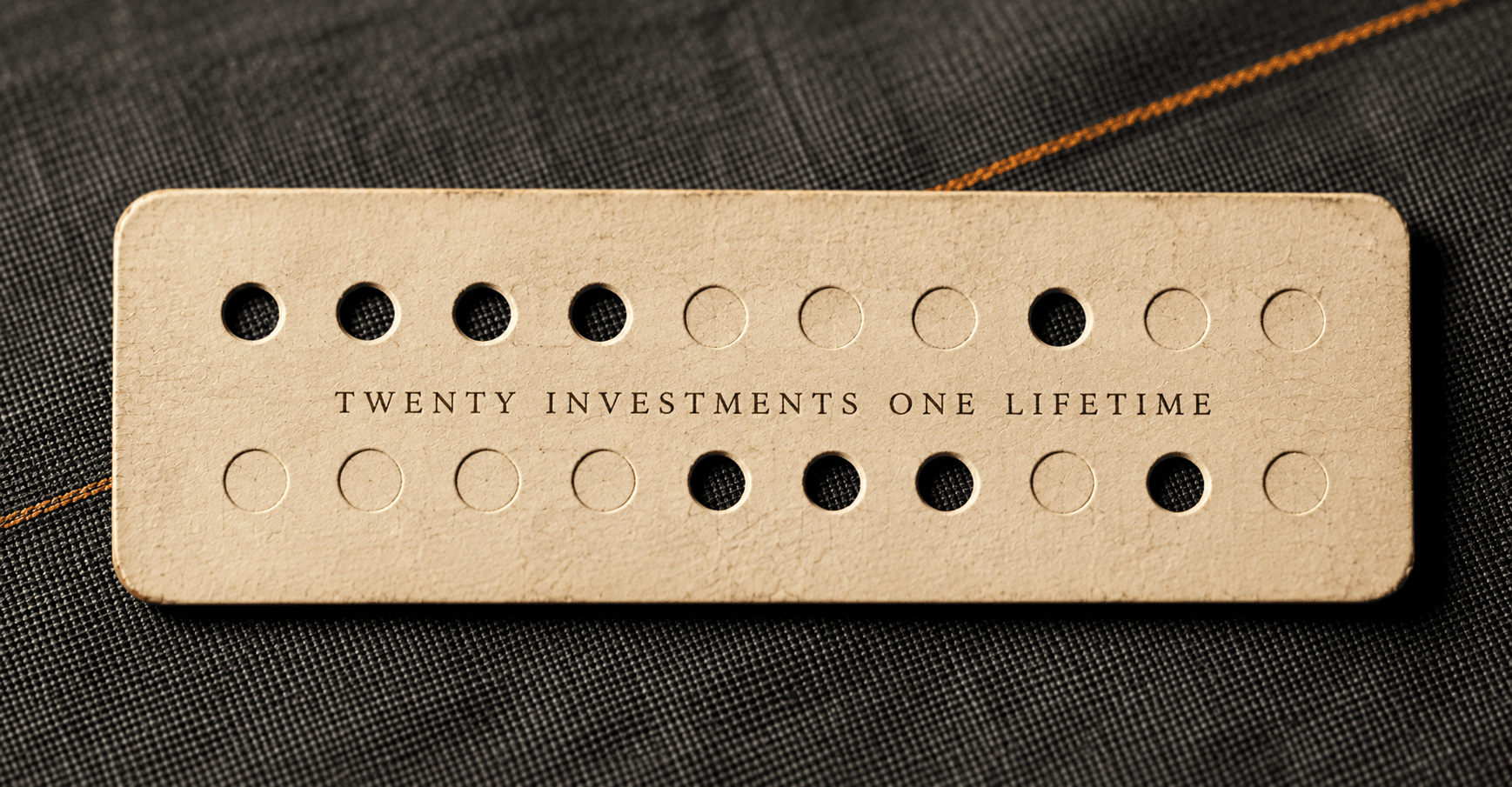
Warren Buffett's punch card rule is a thought experiment: imagine you were handed a card with only 20 slots, each representing one investment you could make for the rest of your life. Once the card is full, you're done. The artificial scarcity forces patience, deep conviction and ruthless selectivity, the opposite of the constant trading the modern market encourages. You don't actually need a literal limit. You just need to invest as if you had one.
One of Warren Buffett's most memorable mental models has nothing to do with spreadsheets, valuations, or market timing. It's a thought experiment:
"I could improve your ultimate financial welfare by giving you a ticket with only twenty slots in it so that you had twenty punches—representing all the investments that you got to make in a lifetime. And once you'd punched through the card, you couldn't make any more investments at all. Under those rules, you'd really think carefully about what you did, and you'd be forced to load up on what you'd really thought about. So you'd do so much better."
You will never actually face this rule. You can buy and sell as often as you like. But that is exactly why the idea is so powerful. It forces you to imagine a world where every decision is permanent and scarce.
The Power of Artificial Scarcity
When something is unlimited, we treat it carelessly. When something is scarce, we treat it with respect.
If you could only ever make 20 investments, you would not waste a punch on a hot tip, a meme stock, or a company you barely understand. Each slot would feel precious.
That single constraint reshapes behaviour:
- You would research far more deeply before committing.
- You would demand a much higher bar of quality.
- You would hold for years, not weeks.
- You would ignore the noise that tempts most investors to act.
Scarcity turns activity into intention.
Why Most Investors Do the Opposite
The modern market is engineered for the exact opposite of the punch card.
Brokerage apps make trading frictionless. Financial news runs all day. Social media rewards bold predictions and quick reactions. Every tool nudges you toward doing more.
But more activity is rarely more profit. Frequent trading tends to produce:
- Higher transaction costs and taxes
- Worse timing, as emotions drive entries and exits
- Shallow research, because there's always another trade
- A portfolio of mediocre ideas instead of a few great ones
When every decision is reversible and free, most decisions stop being decisions at all. They become reactions.
What the Card Forces You to Do
The genius of the punch card isn't the number 20. It's what the constraint demands of you.
Concentrate on Your Best Ideas
With limited punches, you stop diversifying out of fear and start concentrating out of conviction. You put real weight behind the businesses you understand best.
Wait for the Fat Pitch
Like a hitter who only swings at the perfect ball, you learn to do nothing for long stretches. Patience becomes a strategy, not a weakness. The best opportunities are worth waiting for.
Understand What You Own
You cannot punch the card for a company you don't truly understand. The rule quietly enforces Buffett's other great principle: stay within your circle of competence.
Think in Decades
A permanent decision pushes your time horizon outward. You stop asking what a stock will do next quarter and start asking what the business will look like in ten or twenty years.
You Don't Need a Literal Card
The point of the punch card is not to actually limit yourself to 20 trades. It's to borrow the mindset that scarcity creates.
Before your next investment, imagine you're about to punch one of your last few slots. Would this still make the cut?
If it would, you've likely found a genuine conviction. If it wouldn't, you've just saved yourself from a decision you'd probably regret.
Great investing has never been about doing more. It has been about doing less, better.
The next time you're tempted to act, ask yourself one question:
If I only had 20 investment decisions for the rest of my life, would I really spend one of them on this?