Summary
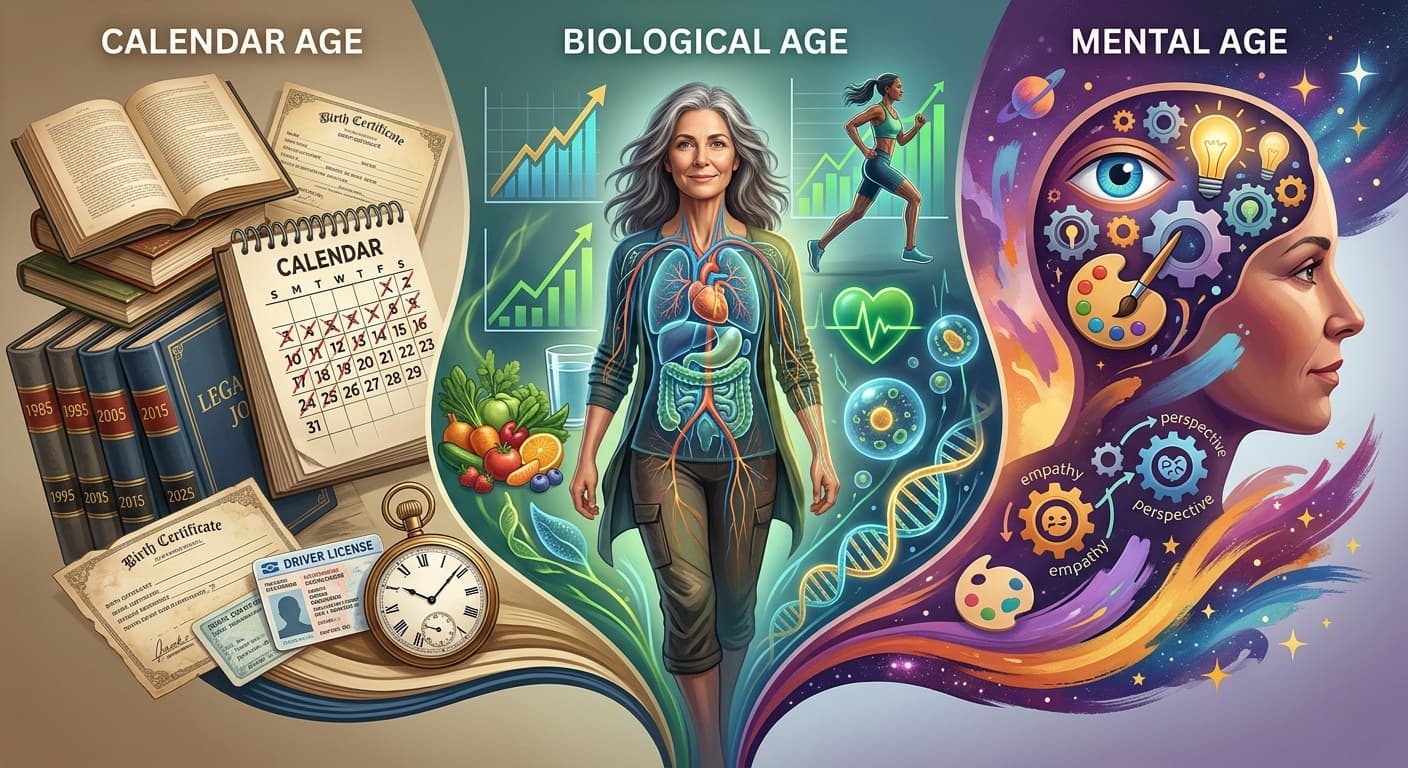
When someone asks how old you are, a single number doesn't capture much. Each of us carries three ages at once: calendar age, the years since birth; biological age, how well the body is actually working; and mental age, your emotional maturity, curiosity and adaptability. Your calendar age is fixed. The other two are largely within your control.
"How old are you?" seems like a simple question. You give a number, clean and universally understood. That number tells a fraction of the story.
Each of us carries three ages at once: calendar, biological and mental. The gaps between them usually explain more about a person than the figure on the birthday cake.
Calendar Age: The Number Everyone Sees
This is the obvious one, the count of years since you were born. It sets legal milestones, school years, retirement eligibility, and how society files you away.
It's also blunt. It assumes everyone develops, matures and declines at roughly the same rate, which is plainly untrue.
Two people can both be 30. One runs marathons, sleeps well and feels energetic. The other is dealing with fatigue, chronic stress and health problems that keep accumulating. Same calendar age, completely different situations.
Calendar age is useful. It just isn't descriptive.
Biological Age: The State of Your Body
Biological age reflects how well your body is actually functioning. Genetics set part of it. Lifestyle sets a lot of it: diet, exercise, sleep. Environment fills in the rest, from pollution to sustained stress.
Unlike calendar age, this one moves in both directions. You can be 40 with the cardiovascular health of someone ten years younger, or the inflammation profile of someone fifteen years older.
This is the age your body feels and performs at, and modern research increasingly tries to measure it directly, through heart health, metabolic function, and markers of cellular ageing such as telomeres and epigenetic clocks.
The useful part is that it's modifiable. Consistent sleep, regular movement, managed stress and decent nutrition compound. They don't just change how you feel day to day. In functional terms they can make your body younger.
Mental Age: The State of Your Mind
The third is the most nuanced and the most underrated. Mental age covers emotional maturity, curiosity and openness, adaptability, and the perspective you bring to your own life.
You've met young people who seem wise well beyond their years, and people in their seventies who approach the world with more curiosity than most twenty-year-olds. This isn't about intelligence. It's about how you engage.
Someone with a young mental age stays curious, keeps learning, treats change as interesting rather than threatening, and holds on to creativity. Someone with an older mental age has strong emotional regulation, thinks in long horizons, and handles relationships with real depth.
The best position is to have both, and neither is fixed. You can shape this one deliberately.
When the Ages Diverge
The interesting part isn't any of the three on its own. It's the gap between them.
High calendar age with low biological age and a young mental age gives you someone vibrant and curious well into later life. Low calendar age with high biological age and a strained mental state gives you someone burned out early, in body and mind. When the three roughly align, it usually reflects balance and self-awareness.
Those mismatches are why some people feel old at 25 and others feel young at 70.
Rethinking the Question
Think in terms of three ages and "how old are you?" becomes a much better question. It turns into: how is your body holding up, how is your mind developing, and how are you choosing to live?
Your calendar age is fixed. The other two are largely yours to influence.
The Takeaway
You can't change the year you were born. You can change how well your body works and how you think, learn and adapt.
Ageing isn't only about time passing. It's about how you move through it.
Next time someone asks your age you'll probably still give them a number. You'll just know it's one clock out of three.